

Saturday morning is easily the day of the week that I look forward to the most. In many ways, it’s the indicator that a long work week has ended and a fun weekend of family-time has begun. Sure, you could start the weekend any number of ways. A bowl of cereal. A cup of Greek yogurt with some fresh fruit. But there’s nothing that screams, “It’s the weekend, baby!” like the decadent and oh-so-simple, Dutch Baby. The Dutch Baby is my favourite homemade breakfast item for a number of reasons.
- It’s relatively cheap to make
- It’s relatively easy to make
- It’s relatively easy to customize
It’s Cheap to Make
The base recipe for a Dutch Baby utilizes household staples that most people should have already around. Meaning, as long as your fridge is packing eggs, you likely won’t have to resort to last-minute grocery hunting at your local, way-too-expensive-but-I’m-in-a-rush Whole Foods market.
- 3 eggs
- 1/2 cup flour
- 1/2 cup milk
- pinch of salt
- sugar to taste
With a dozen organic eggs running you around $3.99, the cost of one Dutch Baby in eggs is just about a dollar. But when you keep in mind that your Dutch baby will feed at least two people well, you’re looking at around 50 cents per person. Throw in your 1/2 cup of flour (~ 0.025 cents), 1/2 milk (~ 0.89 cents), and salt/sugar (are you really going to make me price that out??) and you’re looking at a breakfast that feeds 2 hungry people (3 if one of them has a wimpy appetite), for under $2.00. Now if that’s not a bargain, I don’t know what is!
It’s Easy to Make
Even more basic than your dad’s pancake recipe, the Dutch Baby relies on 3 simple cooking processes: heating, mixing, and (putting in the oven?). Without baking soda or baking powder, the Dutch Baby relies on the eggs to get the lift. What results is, at it’s simplest form, a Yorkshire Pudding/Popover (don’t know what that is? That’s a blog post for another time.). It’s a slightly eggy, crispy but relatively neutral canvas to paint your breakfast on.
The basic process to make a Dutch Baby is as follows:
1. Preheat oven to 400ºF
2. Heat 2 Tbsp of your favourite fat in an oven proof pan. Heat fat until it’s melted and hot.
Two Tips Here: First, I opt for salted butter as it gives the outside a pleasant saltiness after it’s cooked. Second, use a heavy bottomed pan if you have one. I tried to make this in a stainless steel pan once, and it didn’t work out quite right. So if you have a cast iron, that would be most preferable.
3. Mix milk, eggs, flour, salt and sugar in a bowl (or blender for easier clean up) until a thin pancake-like mix is formed. Try to make sure there’s no lumps!
4. Throw your egg mixture into the heated pan with butter (some bubbles should form). And put immediately into your preheated oven for 20 mins.
5. After 20 mins, reduce the oven heat to 325ºF for another 5 minutes. This step could be skipped, however, I think that this step helps to give your Dutch Baby a little more structure for its post-oven-exit.
6. Enjoy! Top it off with whatever you want!
It’s Easy to Customize
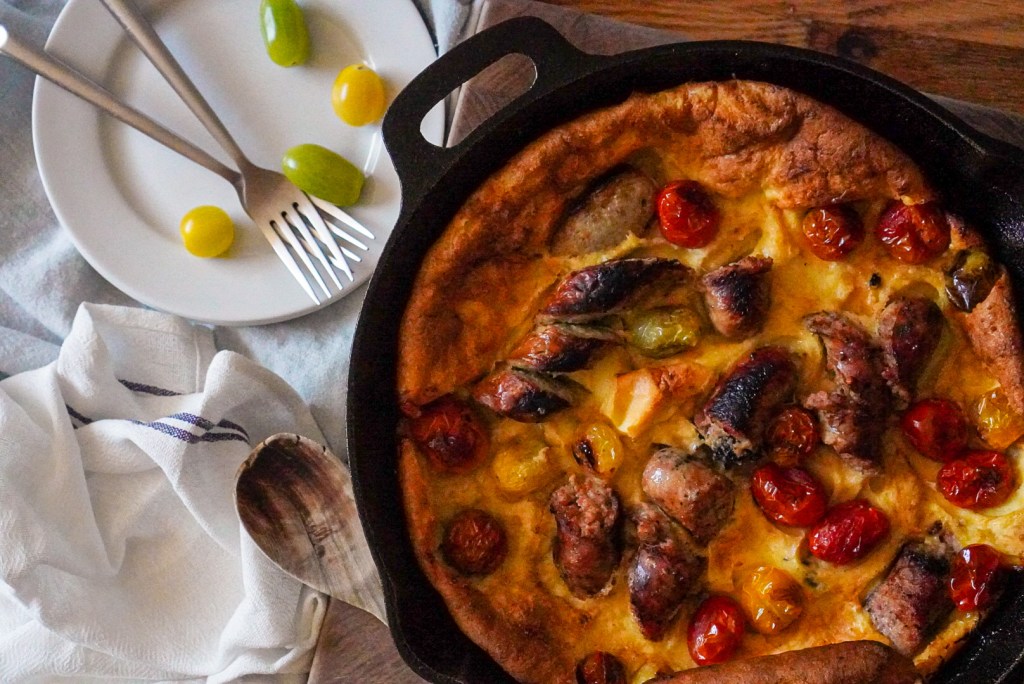
In the picture above, I fried off some sausage and tomatoes in some olive oil before putting the egg mixture in. It sort of worked, but definitely produced a more quiche-esque product. If that’s your jam, go for it!
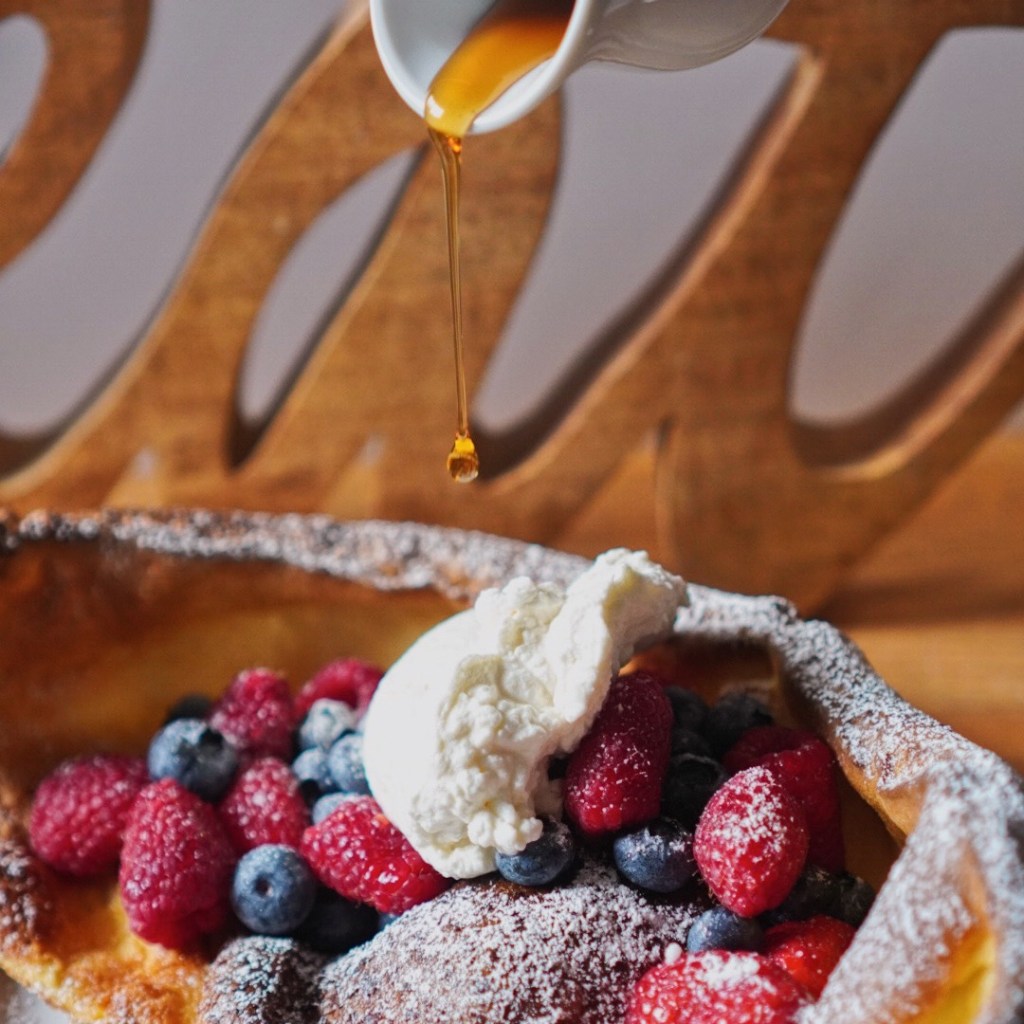
Want something sweeter? Opt for a little more sugar and cover it with berries and whipped cream!
Well, I hope this short post has inspired you to break your Saturday fast in a slightly different way! It’s so simple to make a Dutch Baby, dare I say, fool proof? Next time your stuck in a rut for what to make in the morning, try it out! It’s no fuss and pretty easy to clean up!
Enjoy!
-Ajay
FAQS
Can I double this recipe?
For sure! I’ve doubled this recipe with little problem. However, depending on the size of your pan, you may need to put the mix in two different pans
How would I cook two at the same time?
Great question! Just the same way you would cook two batches of cookies. Set a timer for halfway (10 mins) then switch their places on the oven racks.
Could I use milk or egg substitutes in a Dutch Baby?
I have tried this with milk substitutes (soy and almond milk) and the end result wasn’t really affected – with exception of a slight variation in flavour depending on the kind of milk used. Egg substitutions may be a little trickier as a classic Dutch Baby banks of the eggs for the lift.
If you do try an egg substitute, let me know how it works in the comments!
Can I add other flavourings to the batter (cinnamon, chocolate chips, cocoa powder etc?)
For sure! The rise may not be quite the same though. I’ve tried this recipe with cinnamon (which was delicious btw), but it did affect the rise of the Dutch Baby Pancake. At the end of the day, was that the biggest of deals? No. But if you’re after that “Instagramable, Breakfast Showstopper”, be warned!
 thecultureofcookery.com